
An investigative report by Arthur Hannigan
The power problem in Canada’s community halls, and why townships can’t afford to look away.
This article examines systemic governance challenges in Canadian community halls. It is based on documented trends, research, and legal principles. Any resemblance to specific individuals, municipalities, or organizations is coincidental. For legal advice, consult a qualified professional.
The hall as a microcosm
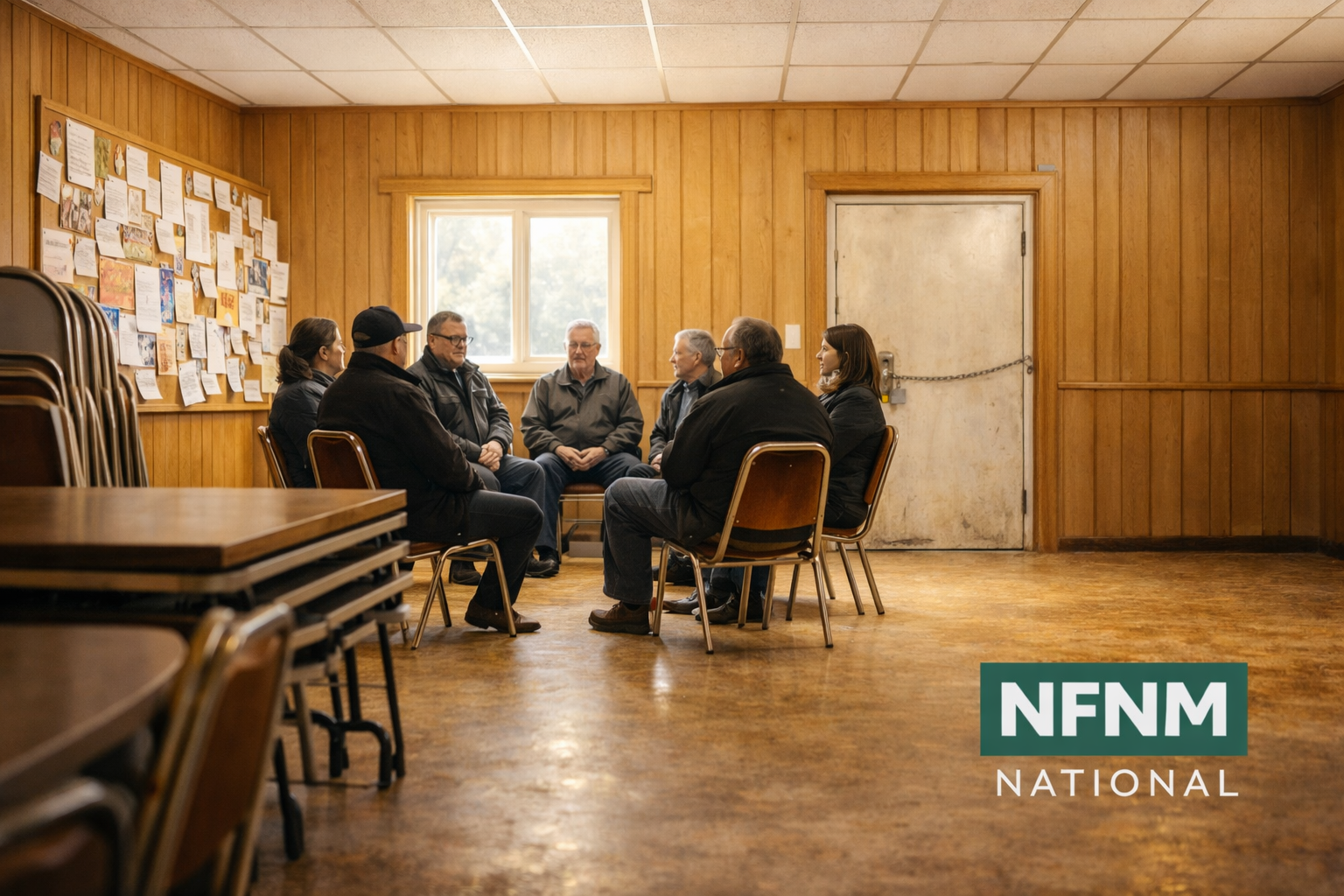
Walk into almost any community hall in Canada and the vibe is familiar: folding tables, a bulletin board layered with notices, and someone behind a desk who seems to hold the keys, literally and figuratively. Ask a question about how decisions get made, and you might get an answer. Push for transparency, and you’ll quickly learn this space has rules, but they were not written with you in mind.
These halls were built on a simple idea: local people pooling resources to create something for everyone. For decades, that is roughly how it worked. Volunteers kept the lights on, ran events, and passed the keys along without fanfare. But somewhere along the way, the culture shifted. What was once a shared resource has, in many communities, become a tightly controlled space, less a public asset and more a personal project for a small group of long-serving insiders. And the part that should concern townships is that they often help fund these halls while asking very few questions about how they are run.
The psychology of control
A significant portion of the people currently running Canada’s community halls spent decades in large institutions, government departments, Crown corporations, school boards, or the military. When they retire, they do not always leave that world behind. They bring its habits, hierarchies, and need for control with them. Researchers call this retirement syndrome. For people who built their identity around institutional power, retirement can feel less like a release and more like a loss. Community halls, with their familiar routines and informal authority structures, become an easy place to recreate that world.
Consider this scenario, drawn from documented patterns: a retired mid-level manager joins his local hall board at his spouse’s suggestion. Within a year, he is chair. Within two, the booking calendar requires his personal approval. A younger volunteer proposing a newcomer drop-in is told there are liability concerns. The hall’s social media has not been updated in years because he does not trust others with access. This is not always malice. It is often a well-intentioned person protecting what they see as their organization. But a community hall is not a government department. The job is not to manage from above. It is to serve the community. When there is no HR, no performance review, and no one to answer to, that distinction gets lost.
The accountability vacuum
On paper, volunteer board members have clear legal duties. They are supposed to act in the organization’s best interests, avoid conflicts, and remain accountable to members. The rules exist. The problem is that rules without enforcement are just suggestions. Most community halls are provincially registered non-profits. They file paperwork once a year and otherwise operate independently. There is no inspector, no routine audit, and no formal complaints pathway for members who feel excluded.
What many halls do have is a constitution last updated decades ago, bylaws nobody reads, and a culture where asking questions makes you the problem. A well-governed organization would have a written complaints process not routed through the same board being complained about, a code of conduct with consequences, accessible financial reporting, and some form of independent oversight. Most halls do not. The vacuum gets filled by whoever is most comfortable with authority and least troubled by the lack of checks.
Why the problem is getting worse
Three pressures are colliding. The first is demographic. The baby boom produced the largest generation of institutionally employed Canadians in history. Many are now retiring into volunteer leadership roles, some with valuable experience, others with a stronger need to control. The second is COVID. The pandemic fractured informal accountability. Longtime members drifted away, while entrenched leaders stayed. Those who remained often held disproportionate influence. The third is the volunteer drought. With fewer people stepping up, those who do hold outsized power. When a board runs on fumes and the chair controls the insurance documents, challenging them becomes a risk few can afford.
The result is predictable: more unchecked control, less oversight, and fewer people willing to push back. In the background, funding the whole system, is the township.
The township’s problem
When a township provides a community hall with subsidized rent, grants, or utilities, it enters a relationship. The further that relationship goes beyond pure funding — owning the building, endorsing the board, listing the hall as a municipal resource — the harder it becomes to claim the township has no responsibility for what happens inside.
Canadian law recognizes nonfeasance, the failure to act when there is a duty to do so. Courts have increasingly held public bodies liable not just for harmful actions, but for inaction when harm was foreseeable and preventable. If a township owns the building, has elected officials on the board, or promotes the hall as a municipal resource, it may share liability for governance failures. Municipal funds are public funds. Funding an organization that operates as a closed shop, excludes members, suppresses dissent, or serves board interests over the community could be seen as misuse of public resources. A township that receives complaints, is aware of governance failures, and takes no action may be held accountable if harm results.
This is not hypothetical. A municipality that continues to fund a dysfunctional organization without conditions, after receiving complaints, is building a legal record that becomes harder to defend over time.
The moral argument, which is also the legal one
Legally, a township might argue it lacks direct control over non-profits. Morally, and increasingly legally, that argument does not hold. Townships know these halls exist. They provide funding, buildings, and political endorsement. They benefit from active community spaces. When a resident calls to say the board is banning people for unclear reasons, the township cannot just shrug and say it is a private organization.
The communities most harmed by dysfunctional hall governance are often the most vulnerable: rural areas with limited infrastructure, small towns where the hall is the only gathering place, and populations such as newcomers and seniors who depend on accessible programming. A township that passively funds these spaces while ignoring governance failures is not neutral. It is complicit.
What townships can do
Municipalities cannot unilaterally rewrite non-profit bylaws, but they can set conditions on public funding. Any new or renewed funding agreement should require publicly posted bylaws and a current membership list with privacy protections, an AGM held on a fixed schedule and advertised to the community, a documented complaints process not controlled by the board, and financial statements available to members upon request. These are not extraordinary asks. They are the baseline of functional governance.
Townships could also require organizations receiving public support above a defined threshold to meet minimum standards such as registered bylaws, term limits for board members, an accessible complaint mechanism, and annual reporting to council. Every municipally supported organization should have a designated liaison, not a board member, to attend AGMs, review annual reports, and flag governance concerns to council. Right now, a resident mistreated by a hall board has almost nowhere to turn. Townships could designate an existing official, such as an integrity commissioner, to handle complaints. The mere existence of that pathway would change behavior.
Close the loop before someone gets hurt
The current system works until it does not. For years, most volunteer boards stayed within reasonable limits. But the combination of demographic shifts, post-COVID governance gaps, and a volunteer drought has created conditions where unchecked control is becoming normalized in spaces people assume are open and community-driven. The harm is already happening through exclusions, silenced dissent, programs that never launch, and residents who stop trying to participate. It just is not making headlines yet.
Legal exposure does not wait for headlines. A municipality that funds a dysfunctional organization without conditions, after receiving complaints, is accumulating risk. When a court asks whether the township had a duty of care, had notice of the problem, and had the power to act, the answer in many cases will be yes to all three.
The fix is not complicated. It does not require new laws or large budgets. It requires townships to do what they should have been doing all along: treating the public money and public assets they provide to these organizations as the basis for basic public accountability. Set minimum governance standards. Create a complaints pathway. Appoint a liaison. Pass a bylaw.
The community hall belongs to the community. The township has been acting like a silent landlord while collecting the political credit of having one. That arrangement has a cost, and right now the community is paying it. The question is whether the township acts before the courts are asked to define what that silence was worth.