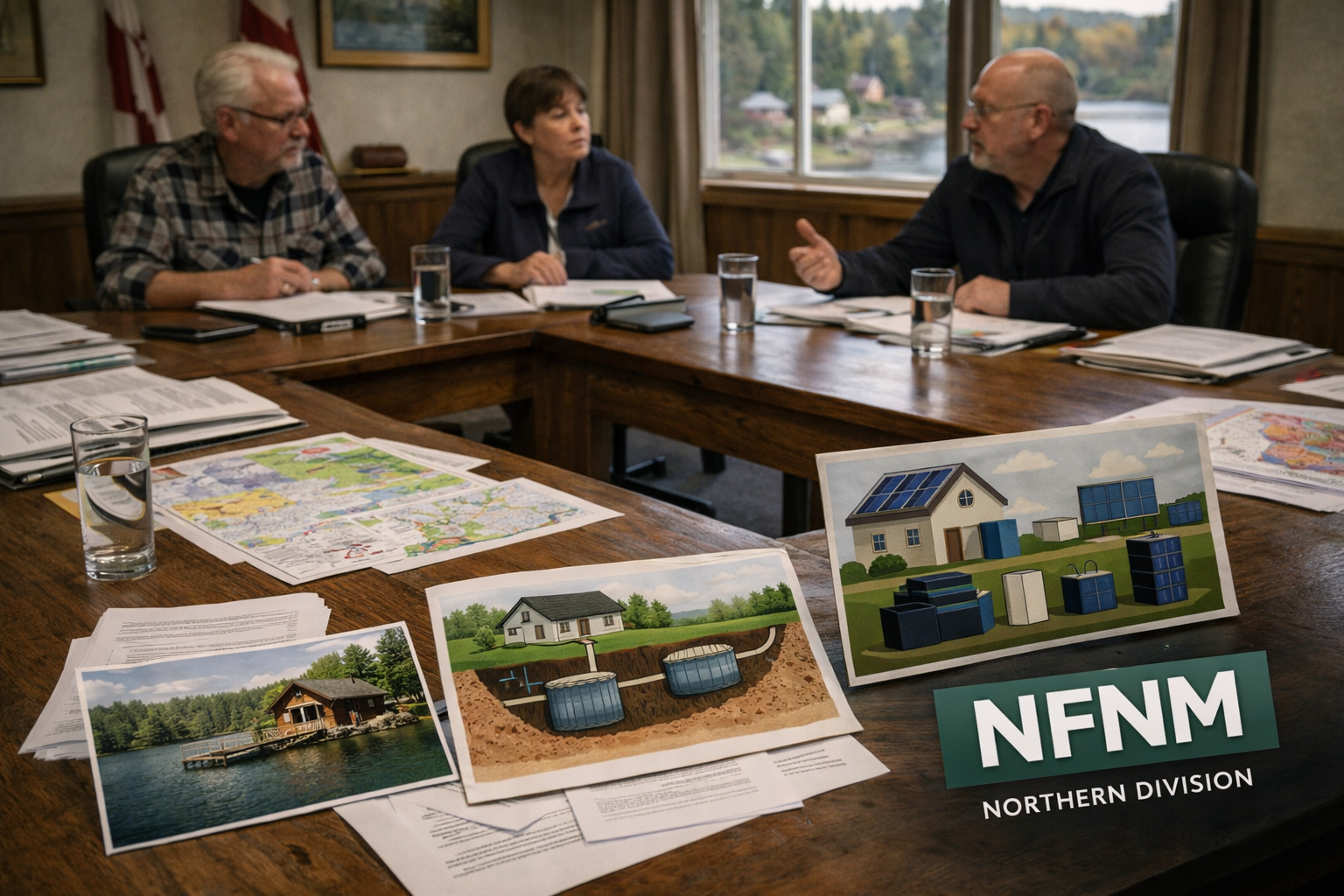
North Frontenac’s Environmental Task Force returns on March 31 with a short agenda, but the work behind it is not small. The February 24 agenda package, together with council’s March 20 meeting, shows three files moving at once: short-term rentals, septic inspections and net metering.
Two of those files already produced action at council. On March 20, councillors directed staff to begin work on a short-term rental licensing bylaw after hearing that 218 commercial STR properties had been identified in the township. In the same meeting, council approved mandatory septic inspections at point of sale for systems older than ten years. Net metering has not reached that stage yet, but the task-force minutes show a live discussion around project cost, rebates, load displacement and the possible role of battery storage.
What links those files is not that they are identical. It is that all three sit at the intersection of growth, infrastructure, regulation and long-term cost. In North Frontenac, those arguments have been building for years. They are now starting to turn into policy.
STRs
Short-term rentals have been circling around North Frontenac politics for years. Reports were written, comparisons were made, residents and lake groups raised concerns, and the township repeatedly left the matter where it was. The March 20 meeting changed that.
At that meeting, Councillor John Inglis presented a report identifying 218 commercial STR properties in North Frontenac. Council then directed staff to begin work on a licensing bylaw. That does not create the bylaw by itself, but it moves the file out of broad discussion and into active municipal work.
The issue had already been building in public and inside NFNM’s own coverage. NFNM had repeatedly argued that North Frontenac was falling behind other Ontario municipalities on STR regulation and had pointed to Tiny Township as a rural model worth studying. Tiny Township licensed and capped STRs, funded enforcement through licensing fees and defended its bylaw in court. By June 2025, NFNM had also noted that 59 municipalities across Ontario already had STR bylaws while North Frontenac still did not.
NFNM’s role in pressing that file should be stated plainly. The Tiny Township comparison did not appear by accident. NFNM had already been pushing it as a workable example for a rural municipality that wanted to regulate STRs without pretending the issue would solve itself. The March 20 council move did not emerge in a vacuum. It arrived after years of local pressure, prior task-force work and repeated public argument about the township’s refusal to put a real framework in place.
What sharpened the discussion further was what Inglis said he found alongside the property count. According to his report, Airbnb was marketing North Frontenac’s unregulated status to prospective hosts, effectively presenting the township as a place where operators could enter the market without a licensing framework already in place. That gives the file a different shape. A township with more than 200 commercial rentals and no licensing system is no longer dealing with a minor policy loose end.
More than 200 identified commercial STR properties operating without a licensing framework during North Frontenac’s worst housing squeeze in memory is not just a market story. It is a measure of how long Mayor Gerry Lichty’s council allowed the file to drift.
The questions now are the ones that decide whether the bylaw will mean anything. What properties will be covered, what standards owners will have to meet, what proof of compliance will be required, what the fee structure will look like, and how North Frontenac expects to inspect and enforce across a municipality of this size are all still unresolved. Those details will determine whether council is building a real system or only the appearance of one.
Septic inspections
The septic file has been moving beside STRs for months, and the reason is not difficult to see. North Frontenac’s septic re-inspection program has existed since 2005, but participation has remained limited. NFNM’s March 20 reporting noted that 53 inspections had been completed out of 540 packages sent. For a township shaped by lakes, waterfront properties and private systems, that left the municipality with a program on paper and weak participation on the ground.
Council’s March 20 decision moved the file into a more enforceable place. Mandatory inspections at point of sale for systems older than ten years tie compliance to the transfer of property rather than voluntary uptake. That is a more practical checkpoint than asking owners to opt in on their own.
The township had already been moving in that direction before the vote. The Environmental Task Force had kept septic inspection programs on its work plan, and NFNM reported earlier in March that staff were recommending council approve a mandatory point-of-sale model in principle while working out details such as costs, exemptions and implementation. Public pressure had been building around the issue as well, including on NFNM’s own Facebook page, where Brandon Hartwig had publicly argued for mandatory septic inspections at time of sale before council adopted the model.
The overlap with STRs has been there throughout the debate. Task-force material had already raised concern about the link between unregulated short-term rentals and septic overuse. That is not the same as proving harm on each identified property, but it explains why council and the task force keep returning to the same two files together. A licensing system that ignores servicing leaves a large weakness in the middle of the file, especially in a township where older septic systems and high-turnover rental use are part of the same local argument.
Net metering
The third file is quieter than STRs or septic rules, but it may carry the longest horizon. The December 23 task-force minutes attached to the February 24 agenda package show members discussing a project in the range of roughly $220,000, with a possible rebate of about $70,000 if the township pursues load displacement rather than a simpler setup based mainly on grid credits. The discussion also touched on battery storage, maintenance assumptions and inverter replacement costs.
That discussion is important in its own right, but there is also a local backstory to it. NFNM had already been pushing the township to think in more ambitious terms about local energy control rather than treating hydro costs as a fixed outside burden. In private discussions with Mayor Gerry Lichty, NFNM had raised the idea of a township-scale municipal setup that borrowed from the logic behind BESS projects: local generation, storage capacity where practical, and more effort to keep the long-term value of the system inside township operations rather than leaving all of that logic to outside structures.
The task-force minutes do not use that exact language, and they do not present the project as a finished battery plan. What they do show is a township beginning to think in that direction. Once project cost, rebate structure, replacement cycles, storage options and load displacement are all part of the conversation, the file has already moved beyond broad green-energy branding and into a more serious infrastructure discussion.
That gives NFNM a second place in this story beyond the STR file. On energy as well, the current direction reflects ideas that had already been pushed from outside formal township channels. North Frontenac is now discussing a municipal energy approach that looks much closer to local control than to a passive wait-and-pay model. Whether council ultimately follows that through is still an open question, but the discussion now on the record is closer to that thinking than it was a year ago.
For now, net metering remains a discussion file rather than a council decision. Even so, it may become one of the more consequential ones. Once a township starts weighing capital cost, rebate structures, storage possibilities and long-term savings, it is no longer talking about symbolism. It is talking about infrastructure, operating cost and control.
What the task force is pointing toward
The March 31 meeting may not generate a major headline by itself, but the direction of the file work is already visible. North Frontenac has reopened the STR issue after years of delay, moved septic oversight into the sale process, and continued to explore an energy file that is becoming more detailed and more consequential the further it moves.
NFNM has not just been watching those files from the sidelines. On STRs, it had already been pressing the Tiny Township comparison and warning that North Frontenac remained unregulated while dozens of Ontario municipalities had already acted. On municipal energy, it had already been pushing the township to think in more self-directed terms about local generation and storage. That does not replace the public record, but it is part of the local history behind why these files are now where they are.
The Environmental Task Force remains one of the places where those issues stay active long enough to turn into council action. Right now, they are some of the most important files on North Frontenac’s board.
NFNM will also be following each of these files separately in the weeks ahead. Short-term rentals, septic inspections and net metering will each receive their own dedicated coverage as the township moves from discussion into implementation.
Sources: North Frontenac Environmental Task Force agenda package dated February 24, 2026, including the December 23, 2025 minutes and work plan update; NFNM prior reporting on the March 20, 2026 Regular Council meeting and related STR and septic files; prior NFNM coverage of STR regulation in North Frontenac and Tiny Township.