
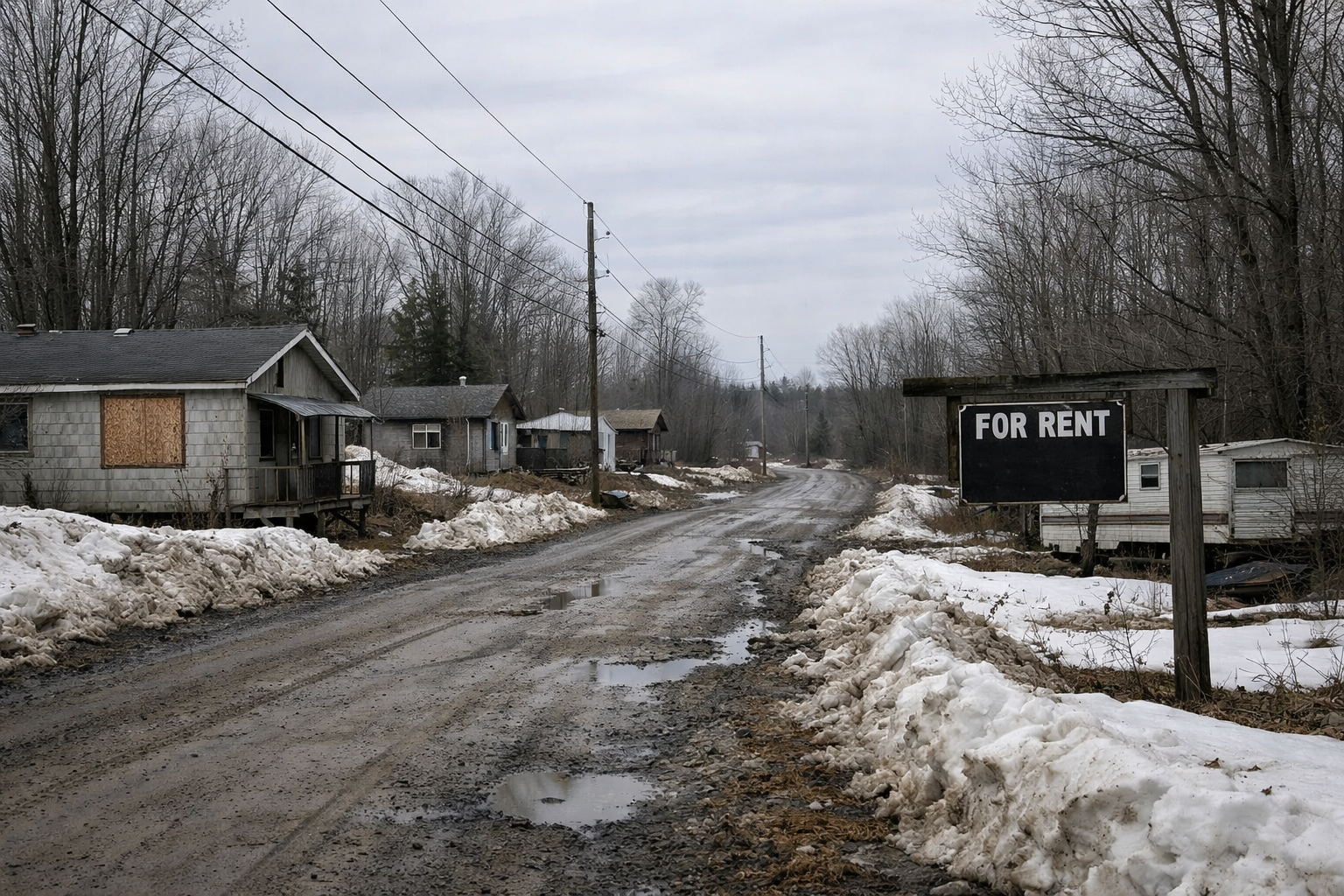
North Frontenac is not approaching a housing crisis. North Frontenac is in one.
The evidence is visible in the hamlets right now. You can see it in the late-winter roads lined with aging houses, old cabins, and seasonal properties that sit dark for much of the year. You can see it in the empty rental sign that does not lead to a workable home for a local worker. You can see it in the boarded window, the muddy snowbanks, the sagging edges of places that once held ordinary life without needing an explanation.
This is not the kind of crisis that arrives with towers, cranes, and headlines about urban growth. Ours is quieter than that, but it is already doing damage. It shows up when the people who keep a township alive cannot find a stable place to live at a price they can carry. It shows up when a young worker leaves because there is no realistic rental. It shows up when an older resident wants to downsize but has nowhere local to go. It shows up when a business owner cannot keep staff because housing has become the first obstacle to every job offer.
It also shows up in the way people talk now. They stop asking where the opportunity is and start asking whether it is still realistic to stay. They stop planning a future here and start measuring how long they can hold on. A place can look quiet from the outside while inside it is full of that kind of calculation. This is not a warning sign for some later date. It is the language of a community already under housing pressure.
The Main Street Test
A small hamlet does not need a shopping district to prove it is alive. It needs enough ordinary housing that ordinary people can stay.
Here is the real test. If the main street of a place like Plevna or another North Frontenac hamlet cannot hold on to workers, young families, seniors, and service people, then every other local ambition becomes harder. Shops struggle. Volunteerism thins out. Schools and community halls lose momentum. Economic development turns into a slogan because the community is no longer set up to hold the people growth is supposed to benefit.
This is why housing should not be treated as a side file. It is not separate from local business, youth retention, emergency services, or community stability. It sits underneath all of them. In North Frontenac, it is already constraining all of them.
There is a bad habit in municipal conversation where housing gets framed as if it belongs to someone else. Maybe the province will solve it. Maybe the market will sort it out. Maybe a private project will appear. Maybe a grant will arrive. In a rural township, that kind of thinking is a way of postponing responsibility. North Frontenac does not need to solve all of Ontario’s housing failures. It does need to understand its own local version of the problem clearly enough to stop pretending that time alone will fix it.
For a place this size, the issue is not mass density. It is whether there are enough lawful, modest, year-round housing options for the people who already belong here or want to build a life here. That means attainable rentals. It means small homes that can actually be approved and financed. It means making room for seniors who want to stay local without carrying a full detached house forever. It means giving younger residents a way to begin adult life here without needing outside wealth to do it.
Young people are being hit first because they are usually the ones with the least margin. They are trying to leave home, start families, take jobs, build businesses, or return after time away, and they are running into a wall of scarcity. A township that cannot house its young adults is not preserving itself. It is aging in place and calling it stability.
Entrepreneurs are being hit too. A person who wants to open a shop, launch a service, run a trade business, or take a chance on a local idea needs somewhere realistic to live while the business gets established. If housing is insecure or unaffordable, the risk of starting anything multiplies. The township does not just lose residents that way. It loses initiative.
North Frontenac already knows this in pieces. It has talked about growth, local business, and community renewal for years. It has also spent real time debating the mechanics of housing: tiny homes, affordability, hamlet growth, and how to make room for more than one dwelling on a property. Those are not abstract discussions. They are evidence that the pressure is already on the table. The problem is that the lived reality on the ground is still moving faster than the policy pathway.
When those options do not exist, the main street starts sending signals long before a formal report does. A storefront cannot find staff. A service cuts its hours. A family doubles up in a living arrangement that was only supposed to be temporary. Another resident accepts a longer commute because they cannot live near the work anymore. None of these moments look dramatic in isolation. Together they tell you whether a hamlet is still functioning as a community or only surviving as scenery.
What Rural Loss Looks Like
In rural Ontario, decline rarely looks dramatic at first. It looks like a unit that never comes back onto the long-term market. It looks like a family that gives up after months of searching. It looks like another property becoming seasonal, another year-round resident moving away, another employer quietly adjusting expectations downward because they know the workforce pool is shrinking.
This kind of loss is easy to normalize because each piece seems small on its own. Together, it is how a township bleeds away good people and opportunity while pretending the emergency has not yet arrived.
North Frontenac does still have options. Council has already been forced into housing conversations around tiny homes, affordability, and the shape of future local development. Those conversations matter. But they need to become more than scattered gestures. The township needs practical pathways for modest homes, lawful year-round living, and realistic small-lot or pilot-style housing options that match the scale of this community.
One example is already sitting in public view. The Plevna tiny house lot idea is not a fantasy sketch about some distant future. It is a practical local concept for a small number of legal, buildable lots designed for modest housing near the village. A proposal like that matters precisely because the crisis is current. If housing pressure were merely theoretical, there would be no need to start thinking in that direction at all.
The danger in rural places is that loss can hide behind beauty. Lakes remain beautiful. Forest roads still look familiar. Tourists still arrive. Seasonal traffic can even make a place seem busy. But that surface activity can cover a deeper weakness. If the year-round population is aging, if younger households cannot get established, and if workers cannot secure a stable address, the place is not strengthening. It is already being hollowed out.
The damage is economic, but it is also moral. A township should not only be arranged for those who already own property comfortably or those who can treat a house as a second-life accessory. Communities remain communities when they can still make room for mechanics, PSWs, tradespeople, clerks, young couples, single parents, fixed-income seniors, and the ordinary people who make daily life function. When those people are steadily pushed to the margins, the place may still look attractive, but it is becoming less honest.
Rural housing pressure also distorts public debate. Every proposal becomes emotionally overloaded because scarcity makes everyone defensive. A modest idea gets treated like a threat. A practical reform gets swallowed by fear, rumour, or personal grievance. Scarcity does that. It turns every housing conversation into a referendum on identity because people know, even if they do not say it plainly, that there are too few workable options right now to absorb disagreement calmly.
Part of the reason North Frontenac needs more seriousness now is simple. Not more panic. Not more empty branding. Seriousness. If a hamlet cannot support long-term residents, then every other plan for economic development, tourism, or civic renewal sits on a weak foundation.
What A Township Can Actually Do
The good news is that rural municipalities are not powerless. They are limited, but they are not powerless.
North Frontenac can examine whether its zoning and approval pathways are helping modest housing happen or quietly blocking it. It can decide whether tiny-home rules reflect real installation practice instead of outdated assumptions. It can look seriously at small-lot models, pilot projects, and village-adjacent opportunities that create legal places for people to live without forcing urban-scale solutions onto a rural landscape.
This is not speculative. NFNM has already documented one of the simplest local examples: the Township’s own tiny-home language has created confusion around how a lawful tiny home, especially one built on a chassis, is supposed to fit the rules. When definitions are muddled, residents lose time, staff lose clarity, and practical housing gets delayed before a shovel ever touches the ground. A housing crisis does not only live in price tags. It also lives in bad pathways.
It can also stop treating affordability as a vague aspiration. Affordability has to mean something concrete in relation to local wages and local life. If the only homes being added are out of reach for people who actually work in or near the township, then the supply conversation is incomplete. Quantity matters, but fit matters too. A place can add units and still fail the people it claims to be building for.
The people being failed first are not abstract categories. They are younger residents trying to get started. They are entrepreneurs trying to create work in a township that says it wants growth. They are the very people North Frontenac says it wants to retain, attract, and support. If those people cannot find a stable foothold, then the housing crisis is not theoretical. It is already interfering with the township’s future in practical, measurable ways.
North Frontenac needs to face that contradiction directly. A township cannot say it wants more economic activity in places like Plevna, Ompah, and the rest of its settlement areas while leaving younger adults and local operators to improvise their housing one crisis at a time. A pro-growth message without a housing lane underneath it is not a plan. It is a slogan with no floor under it.
This is where local leadership matters. Council does not need to promise miracles. It needs to show that it understands the file as a structural issue, not a passing topic. That means consistency. It means moving from reaction to design. It means creating a few workable lanes and then staying with them long enough to produce visible results.
North Frontenac has already touched parts of this file. Tiny homes have been debated. Housing advisory work has existed. Affordability language has entered the conversation. That is better than silence, but it is not yet enough. The next step is proving that the township is willing to connect those conversations to actual pathways people can use.
A Place Has To Be Livable To Have A Future
The point is simple. A place cannot market its beauty forever while quietly pricing out the people who make daily life possible.
If North Frontenac wants living hamlets instead of hollowed-out postcards, housing has to be treated as core local infrastructure. Not decorative policy. Not a talking point. Infrastructure.
Because once the lights go dark on enough homes, the main street tells the truth before council ever does.